HE CAME HOME FROM WORLD WAR II IN UNIFORM — HOURS LATER, A POLICE BEATING LEFT HIM PERMANENTLY BLIND 💔🇺🇸
Posted by Max - September 16, 2026
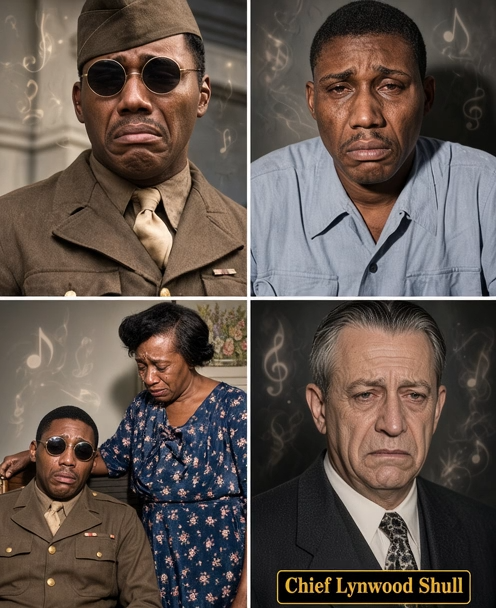
He came home from World War II wearing his Army uniform. Hours later, a police beating left him permanently blind.
Isaac Woodard had survived the war.
He had served his country in the Pacific, earned a battle star, and finally received his honorable discharge on February 12, 1946.
At 26 years old, he was supposed to be going home.
Instead, somewhere between Georgia and South Carolina, his journey became a nightmare.
Woodard was riding a bus toward his hometown when he asked the driver whether there would be enough time during a stop for him to use the restroom.
An argument followed.
When the bus reached Batesburg, South Carolina, the driver sought help from local police.
Woodard was taken off the bus.
What happened next would permanently change his life — and expose one of America’s ugliest contradictions.
Police Chief Lynwood Shull reportedly struck Woodard repeatedly with a blackjack.
The blows landed on his head.
Then his eyes.
Again and again.
By the time the attack was over, both of Woodard’s eyes had been ruptured.
The soldier who had just returned from serving America could no longer see.
But the nightmare didn’t end there.
Woodard was taken to jail.
The following morning, despite being unable to see, he was brought before a local judge and charged with being drunk and disorderly.
The court gave the blinded veteran a choice:
Pay a $50 fine.
Or spend 30 days on a chain gang.
Think about that for a moment.
A Black Army veteran had just returned from a war fought in the name of democracy.
A police officer had beaten him until he lost his eyesight.
And the first response of the local justice system was to punish him.
Doctors at a Veterans Administration hospital in Columbia later determined that the damage was permanent.
There was no surgery that could give Woodard his vision back.
He had survived the Pacific.
He had made it home.
And within hours of leaving the Army, he had been robbed of his sight.
Then his story began reaching far beyond South Carolina.
The NAACP took up his case.
Radio personality Orson Welles spoke publicly about the attack.
Eventually, investigators identified Lynwood Shull as the officer responsible.
And suddenly, the story of one blinded veteran became a national civil rights issue.
Woodard’s case attracted enormous attention.
In August 1946, nearly 20,000 people filled New York’s Lewisohn Stadium for a benefit organized in his honor. Thousands more reportedly couldn’t get inside.
Joe Louis was involved.
So were major performers including Billie Holiday, Count Basie, Pearl Bailey, Woody Guthrie, and the King Cole Trio.
When Woodard appeared before the crowd, the applause reportedly lasted for several minutes.
But he didn’t use the moment simply to talk about revenge.
He spoke about what had happened to him and expressed hope that his suffering could help prevent someone else from experiencing the same thing.
Then came the courtroom.
On November 5, 1946, Woodard testified against Lynwood Shull in federal court.
He had lost his eyesight.
But he still came forward.
The trial was brief.
The jury was entirely white.
And after a short deliberation, Shull was acquitted.
The man accused of beating a young Black veteran blind walked out of the courtroom a free man.
Woodard had lost his sight.
And now he had lost faith that the justice system would punish the person responsible.
But the story wasn’t over.
Someone else had been listening.
Federal Judge J. Waties Waring presided over the case. What he encountered through Woodard’s testimony and the broader racial injustice surrounding the case would contribute to his later transformation into an outspoken critic of segregation.
Waring would eventually become the lone dissenting judge in Briggs v. Elliott, a school-segregation case that became part of the landmark Brown v. Board of Education decision.
And Woodard’s case was reaching the White House.
President Harry Truman met with NAACP leaders in September 1946 to discuss racial violence against Black Americans, particularly Black veterans returning from World War II.
Woodard’s beating became one of the cases placed directly before the administration.
Truman began asking whether the federal government needed to do more than investigate individual incidents after they happened.
Something larger followed.
In December 1946, Truman created the President’s Committee on Civil Rights.
Its 1947 report called for stronger federal protection of civil rights and attacked some of the nation’s most deeply rooted forms of racial inequality.
Then, on July 26, 1948, Truman signed Executive Order 9981.
It declared that there should be equality of treatment and opportunity in the U.S. armed forces regardless of race, color, religion, or national origin.
The military was not transformed overnight.
And Isaac Woodard did not single-handedly end segregation.
That victory belonged to generations of Black veterans, activists, lawyers, organizers, and ordinary Americans who fought against racial discrimination.
But Woodard’s story became impossible to ignore because it revealed a devastating contradiction.
America had sent a Black man overseas to fight for freedom.
He returned home in uniform.
And his own country allowed a police officer to beat him blind without ever holding that officer criminally accountable.
Woodard eventually rebuilt his life in New York.
He learned to live without the eyesight he had once taken for granted. His disability benefits eventually improved, and he invested in property in the Bronx.
But he carried the consequences of that night for the rest of his life.
In September 1992, Isaac Woodard died at 73.
He was buried at Calverton National Cemetery among fellow veterans.
He never saw the world again.
He never saw the people who came after him.
He never saw the changes his case helped inspire.
And Lynwood Shull was never convicted for blinding him.
For years, Woodard’s name slowly disappeared from the national conversation.
But the story should never have been forgotten.
Because before many of the civil rights battles Americans recognize today, there was a 26-year-old Black soldier sitting in a courtroom, unable to see the judge who was sentencing him.
He had fought America’s war.
Now America had to confront what happened when he came home.
They took his eyesight.
They couldn’t erase what his story revealed.
✓ Max
He came home from World War II wearing his Army uniform. Hours later, a police beating left him permanently blind. Isaac Woodard had survived the war. He…