There was one major problem.
The image was blurry.
The person was pH๏τographed from a distance, facial details were difficult to distinguish, and the image itself could not conclusively establish that the individual was Nolan.
The pH๏τograph therefore may be a piece of the puzzle, but it cannot independently settle the timeline.
And that distinction matters enormously.
If Nolan was alive at 6 p.m., investigators would have to focus heavily on what happened after that point.
If the identification was mistaken, however, the timeline could look very different.
THE MARK ON THE BACK OF NOLAN’S HEAD
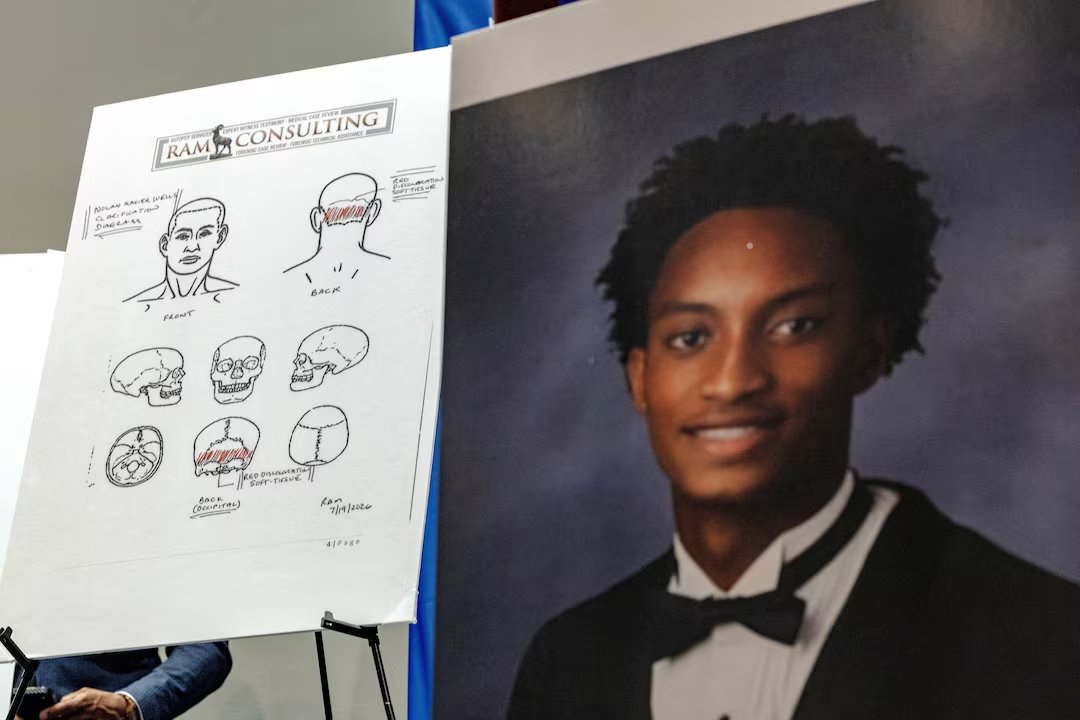
One of the most troubling elements involves the forensic examination.
The supplied material describes a significant area of injury on the back of Nolan’s head.
That finding naturally raises several possibilities: Nolan could have suffered a blow before entering the water, sustained an injury during an accident, struck an object in or near the water, or been injured through some other mechanism.
But the existence of an injury does not automatically establish foul play.
Accidental falls, submerged objects, boats, waves and other environmental factors can potentially cause traumatic injuries.
At the same time, the finding explains why questions about Nolan’s death have persisted.
If drowning occurred, investigators still have to determine what happened immediately before it.
WHY WERE THE LUNGS AND NECK EXAMINED?
The material also discusses detailed examination of Nolan’s lungs and neck tissue.
Examining the lungs can be relevant when forensic specialists are investigating possible drowning.
Examination of the neck can also provide information relevant to determining the circumstances and mechanism of death.
However, the material does not provide a definitive official finding establishing strangulation or another specific neck injury.
That distinction is essential.
The fact that forensic specialists examined or retained particular tissue does not, by itself, prove that Nolan was strangled, restrained, or ᴀssaulted.
Only the complete forensic evidence can establish what those findings actually mean.
THE QUESTION SURROUNDING NOLAN’S PHONE
Then there is Nolan’s phone.
According to the discussion contained in the supplied material, at that stage the phone had not been turned over to investigators.
That became significant because a smartphone could potentially contain location history, communications, calls, messages and other digital information relevant to Nolan’s final hours.
Such information could potentially help answer crucial questions.
Where was the phone after 4:30 p.m.?
Who communicated with Nolan?
What were his final messages?
Could location information corroborate or contradict the reported 6 p.m. sighting?
Digital evidence could become especially important because memories can be mistaken, while properly authenticated electronic records may help establish a more precise timeline.
THE CONTROVERSIAL AUDIO
Recordings ᴀssociated with the events also became a major source of online speculation.
Multiple versions circulated on social media, with different people claiming they could hear incriminating statements or conversations.
But the supplied material contains warnings that versions of the audio may have been altered, manipulated, enhanced or even artificially generated.
The existence of multiple competing versions severely complicates efforts to determine what was actually said.
Without an authenticated original recording, viral audio should not be treated as definitive evidence.
ONE QUESTION REMAINS ABOVE ALL OTHERS
After all the competing theories, witness statements and forensic questions, the central mystery remains remarkably simple.
If Nolan Wells really was alive on Horn Island at 6 p.m., what happened next?
Who was the last confirmed person to see him alive?
How did he enter the water?
When did the injury to the back of his head occur?
Can phone records, location information, boat data, witness statements and forensic findings eventually be combined into one reliable timeline?
The source material ends with essentially that same unresolved question: if the 6 p.m. witnesses are correct, the hours that followed represent the largest remaining gap in the story of Nolan Wells’ final movements.
Until the relevant forensic findings, digital evidence and witness accounts are fully established, theories ranging from an accident to possible involvement by another person must remain exactly that — theories under examination, not proven conclusions.
What happened to Nolan Wells cannot ultimately be determined by viral pH๏τographs, edited audio or online accusations.
It will be determined by evidence.